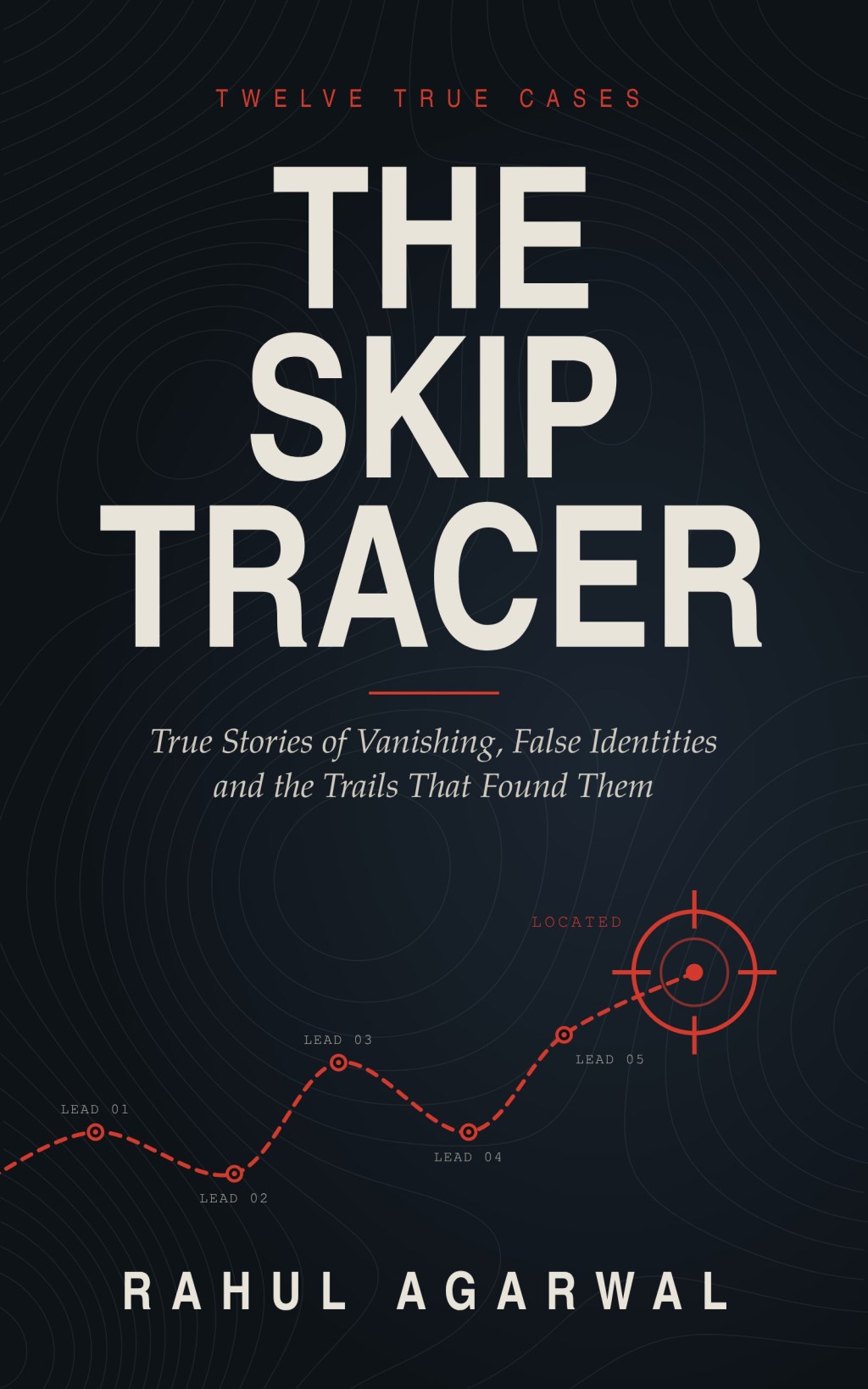
People disappear for all kinds of reasons. Some run from the law. Some run from debts, marriages or mistakes. A few go to extraordinary lengths: a new name, a new country, even a faked death. And yet, again and again, they are found.
That’s the question at the heart of my new book, The Skip Tracer: True Stories of Vanishing, False Identities and the Trails That Found Them. It isn’t only about how people vanish. It’s about how they’re found.
Twelve true cases
A Rolex pulled from the English Channel in a fishing net leads police to a financial adviser who vanished from Ontario years before. A bank teller wanted since 1969 over the disappearance of $215,000 is identified only after his death, half a century later. A woman lives for twenty-two years under the name of a child who died. A pilot bails out of his own aircraft and leaves it to fly on without him.
These are some of the twelve real cases in the book. Others involve a borrowed name that held up for decades, a face rebuilt in clay, a photograph that undid a man who had “died” at sea, stolen gold, and a repo man who recovers aircraft around the world.
Lead by lead
Each chapter opens with a short scene, then follows the case the way an investigator would: the vanishing, the people hunting for the missing person, and the trail, one lead at a time. You’ll see what made each case hard, and the small details that finally connected an old identity to a new one.
Every case is drawn from court records, official statements and published reporting. Where the sources disagree, the book says so rather than picking the more dramatic version, and where the sources are silent, it doesn’t guess.
The Tracer’s Notebook
Every chapter ends with a Tracer’s Notebook: practical lessons for anyone who traces people for a living, with notes on how an investigator in Ontario might approach the same problem today. Some lessons are about technique, such as tracing the object instead of the person, or testing the earliest document behind an identity. Others are about the limits: what the law allows, what a licence does and doesn’t permit, and when to hand information to the police.
Why I wrote it
I’ve spent decades as a military and commercial pilot, and today I run a licensed private investigation agency in Ontario. Flying teaches you that small details matter and that every system leaves a record. Skip tracing works the same way. People can change their names, their towns and their stories, but they rarely change everything. Somewhere there’s a habit, a document, a familiar face or an old connection that still points back to who they were.
I wanted to write a book that true-crime readers would enjoy for the stories, and that working investigators would keep for the lessons.
Who it’s for
- True-crime readers who want real cases told carefully, without exaggeration
- Private investigators, skip tracers and anyone considering the profession
- Anyone who has ever wondered how people disappear, and how they are found
Get the book
The Skip Tracer is available now on Amazon:
https://www.amazon.ca/dp/B0HPYLCBQB
If you read it, I’d be grateful for an honest review on Amazon. Reviews make a real difference to independent authors.
About my agency
When I’m not writing about cases, I’m working on them. My agency provides licensed private investigation services across Ontario. To learn more or get in touch, visit theinvestigators.ca.
Everyone leaves a trail. This book is about the people who follow it.


