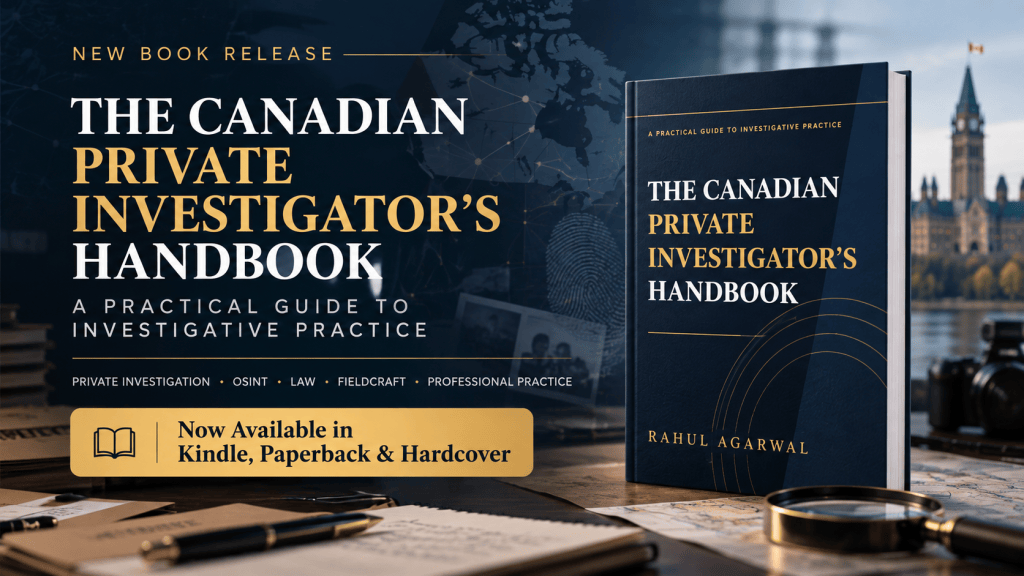
A Practical Guide to Investigative Practice
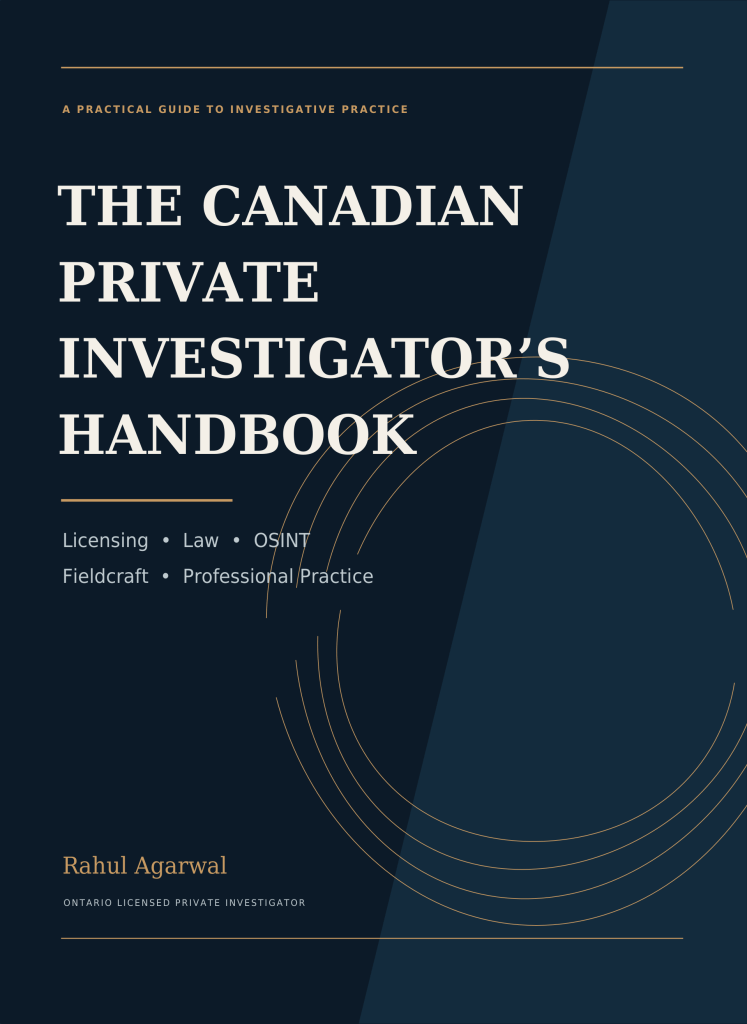
I am pleased to announce the publication of my new book:
The Canadian Private Investigator’s Handbook: A Practical Guide to Investigative Practice
The handbook is now available through Amazon in three formats — Kindle, Paperback and Hardcover.
All three versions became available on September 30, 2026, marking the culmination of a project intended to bring together the legal, ethical, operational and practical elements of modern private investigation into one comprehensive Canadian reference.
View the book on Amazon:
https://a.co/d/0cNT27Xa
Visit my Amazon Author page:
https://amazon.com/author/rahulagarwal747
A Comprehensive Canadian Investigation Handbook
Private investigation today extends far beyond surveillance and conventional field enquiries.
Investigators increasingly operate in an environment shaped by privacy legislation, open-source intelligence, digital footprints, social media, electronic evidence, databases, professional reporting requirements and rapidly evolving technology.
The Canadian Private Investigator’s Handbook was developed as a practical reference for navigating that environment.
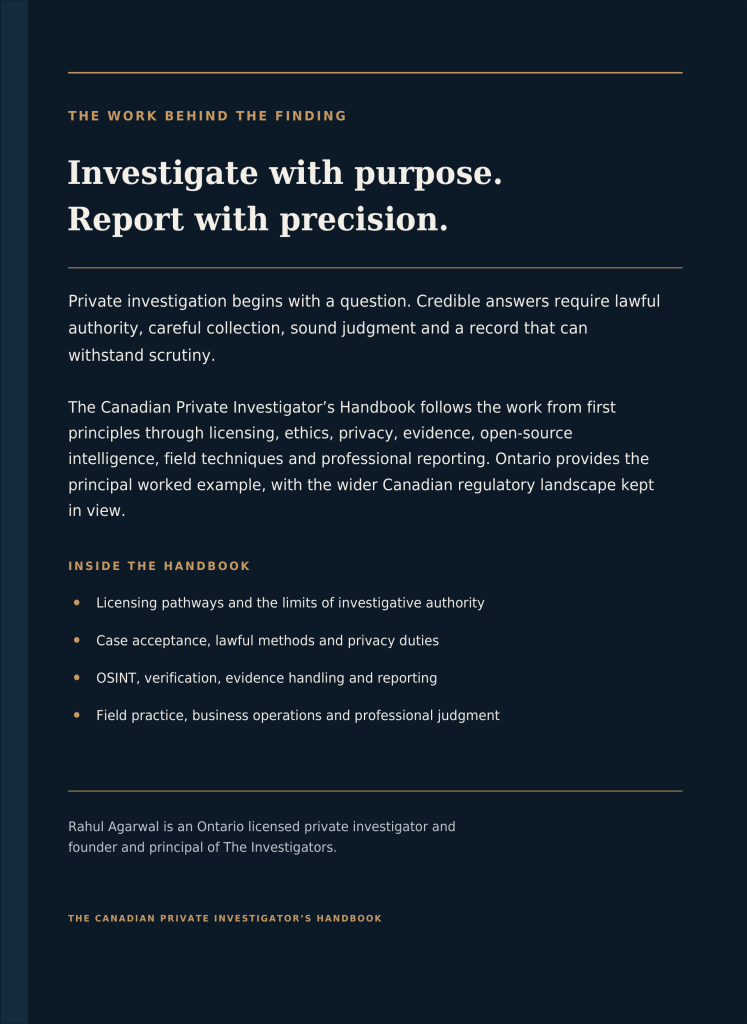
The book follows investigative work from its foundations through licensing, law, ethics, privacy, evidence handling, OSINT, field techniques and professional reporting.
Rather than concentrating solely on theory, the emphasis throughout the handbook is on how investigative principles are actually applied in professional practice.
Book Details
The handbook is a substantial professional reference rather than a short introductory guide.
The Amazon print-edition listing records:
Print length: 590 pages
Language: English
Publication date shown by Amazon: September 29, 2026
Dimensions: 8.5 × 1.33 × 11 inches
ISBN-13: 979-8177967035

Amazon book details for the print edition of The Canadian Private Investigator’s Handbook.
What Does the Handbook Cover?
Across 29 chapters, the handbook examines the investigation process from the fundamentals of professional practice through increasingly sophisticated investigative techniques.
Among the subjects covered are:
• Private investigator licensing and professional responsibilities
• Canadian legal and regulatory considerations
• Privacy and ethical investigative practice
• Planning and managing investigations
• Evidence identification, collection and preservation
• Open-Source Intelligence — OSINT
• Internet and social-media investigations
• Background investigations
• Skip tracing and subject location
• Surveillance and field investigation
• Interviews and information gathering
• Digital evidence
• Documentation and investigative notes
• Analytical techniques
• Professional report writing
• Client management and investigative practice
• Practical tools, checklists and reference material
The objective is not simply to describe investigative techniques, but to place them within the legal, ethical and professional framework in which a Canadian investigator must operate.
Who Is This Book For?
The handbook has been written for a broad professional audience.
It should be useful to new and aspiring private investigators, particularly those seeking to understand what professional investigative work looks like beyond the licensing examination.
It is equally intended as a reference for working investigators and investigation agencies, as well as professionals whose work regularly intersects with investigations, including lawyers, paralegals, insurers, landlords, property professionals, corporate security personnel and others involved in fact-finding and due diligence.
Students and individuals interested in OSINT and digital investigations should also find considerable practical material within the book.
From Traditional Investigation to OSINT
One of the most significant changes in modern investigation is the enormous amount of potentially relevant information that now exists in the public domain.
A skilled investigator may need to move seamlessly between traditional investigative methods and digital research.
A single investigation can involve public records, corporate information, archived webpages, social-media activity, usernames, email addresses, domain registrations, photographs, metadata, mapping information and numerous other digital traces.
But access to information does not automatically make information reliable.
The investigator must still ask:
Where did the information come from?
Can it be corroborated?
Is it relevant?
Was it obtained lawfully?
Can its provenance be demonstrated?
And can it ultimately withstand scrutiny?
Those principles are central to the approach taken throughout the handbook.
Investigation Is Ultimately About Evidence
Technology can dramatically expand what an investigator is capable of discovering, but investigative work remains dependent upon disciplined methodology.
Information must be distinguished from intelligence.
Intelligence must be distinguished from evidence.
And evidence must be collected, preserved, analyzed and reported in a manner that allows another person to understand not only what was discovered, but how it was discovered.
For that reason, the handbook places considerable emphasis on evidence handling, documentation, corroboration and professional reporting.
Why I Wrote This Handbook
My own professional journey has crossed several very different disciplines.
I began my career in military aviation with the Indian Air Force, serving as a fighter pilot, Fighter Weapons Instructor and eventually attaining the rank of Wing Commander.
I subsequently transitioned into civil aviation and commercial airline operations in Canada, including training and command responsibilities, and today continue to fly professionally as an airline captain.
Later, I entered another field built around disciplined observation, analysis, decision-making and evidence: professional investigation.
I am an Ontario-licensed private investigator and founder and principal of The Investigators, an Ontario investigation practice with a particular interest in modern research, background investigations and open-source intelligence.
Although aviation and investigation may appear to be very different professions, they share several fundamental principles: disciplined preparation, verification of information, procedural integrity, accurate documentation and the ability to separate assumption from evidence.
Those principles strongly influenced the approach taken in this handbook.
A Practical Reference — Not Just a Textbook
My intention was to produce something that could remain beside an investigator’s computer or on an office bookshelf and be consulted whenever required.
A professional handbook should answer practical questions.
What should I look for?
Where should I look?
How should I document it?
What are the legal and privacy considerations?
How do I preserve what I find?
How do I distinguish a lead from a verified finding?
And how should the final result be presented professionally?
That practical philosophy runs throughout the book.
Available Now on Amazon
The Canadian Private Investigator’s Handbook: A Practical Guide to Investigative Practice is now available in:
Kindle Edition
Paperback Edition
Hardcover Edition
View the Book on Amazon
Visit My Amazon Author Page
Visit The Investigators
The Canadian Private Investigator’s Handbook
Licensing • Law • OSINT • Fieldcraft • Professional Practice
A practical reference for the evolving world of Canadian private investigation.
Rahul Agarwal
Author | Ontario Licensed Private Investigator
Founder & Principal — The Investigators


